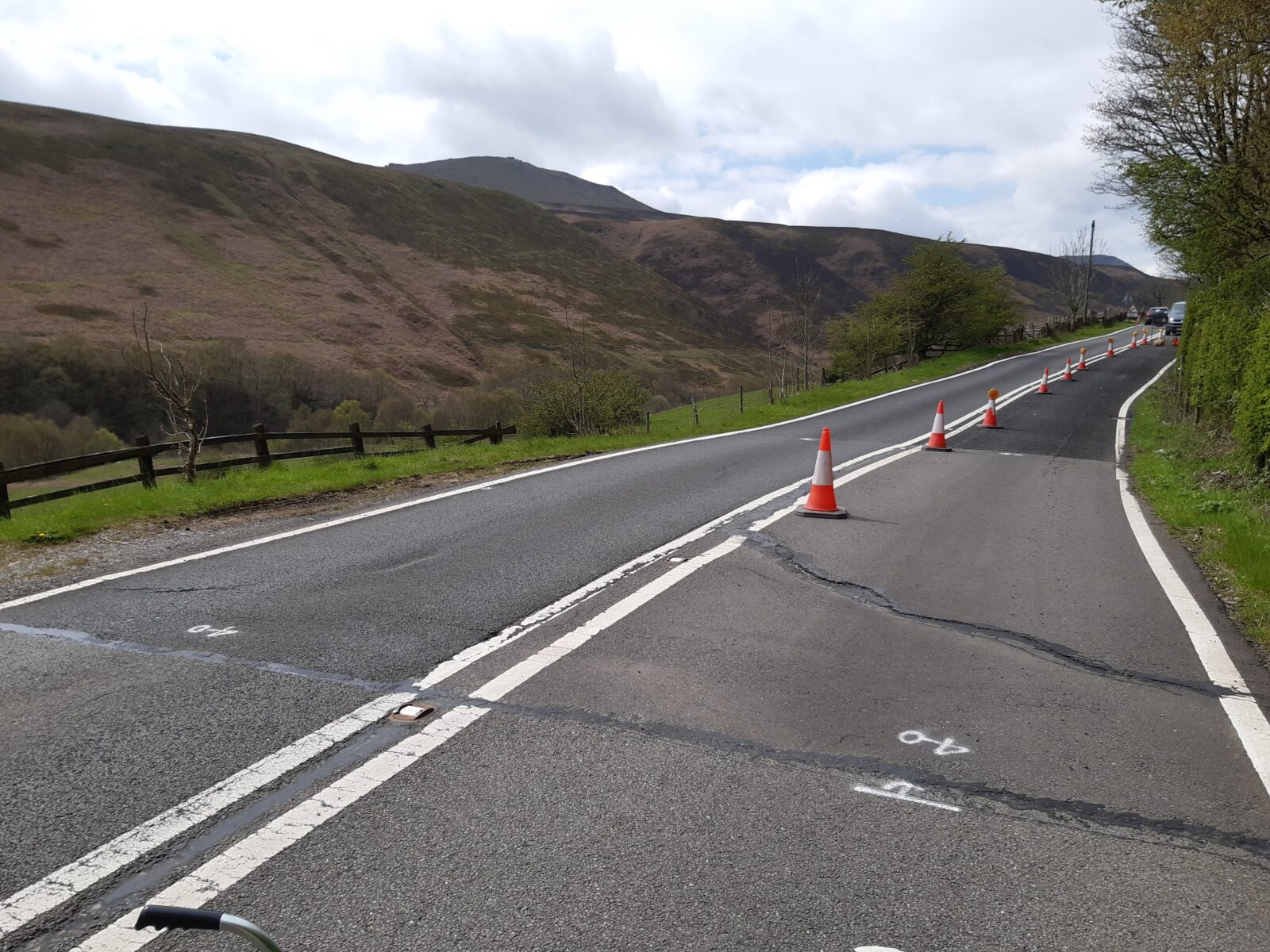
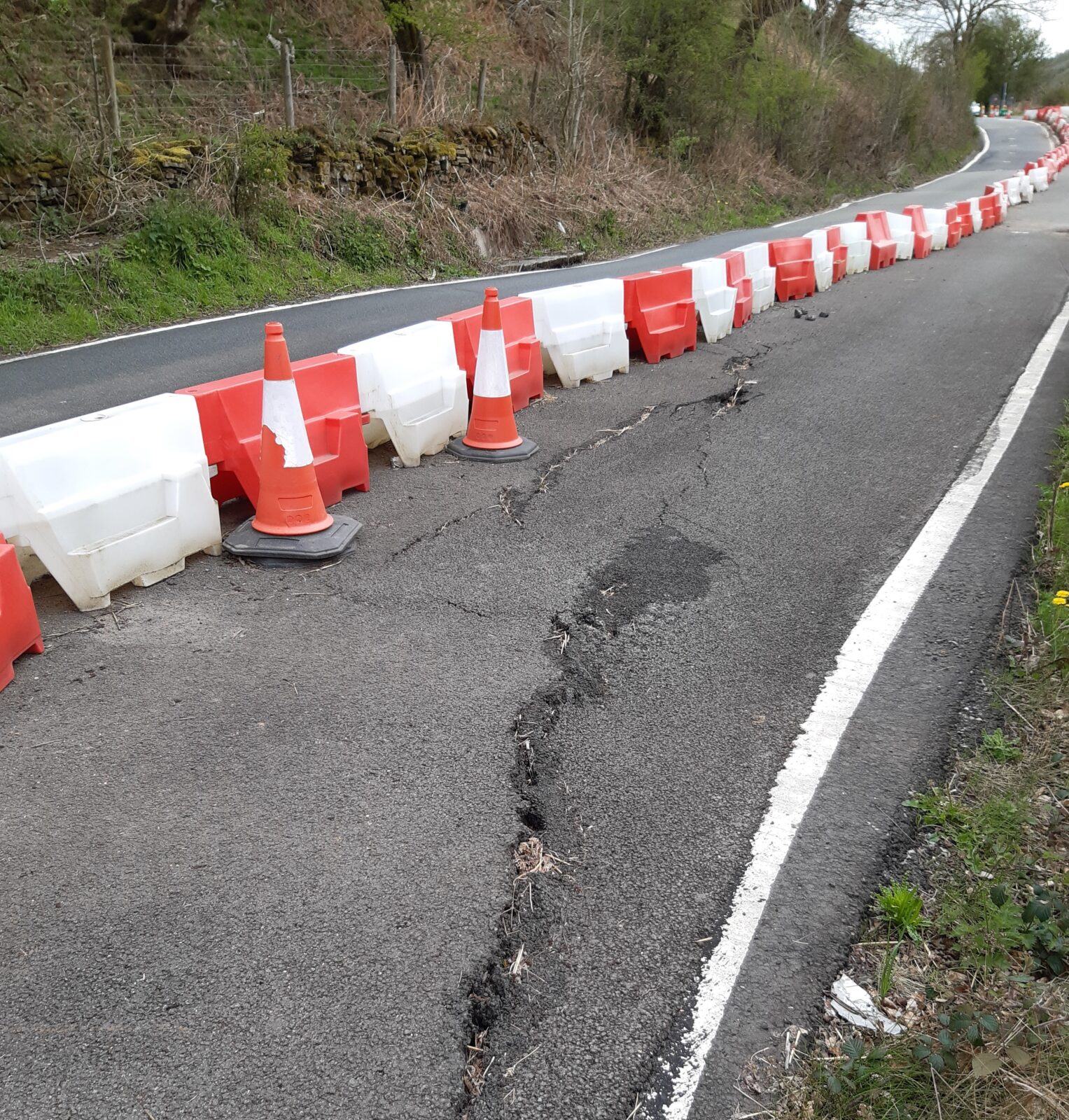
Snake Pass is considered one of the most beautiful (and dangerous) roads in the country, with its winding route through the Peaks making it a wildly popular destination for cyclists.
So a group of local cyclists are again planning an organised bike ride to the summit, setting off from Norfolk Square in Glossop at 6.30pm on Wednesday 24 May.
The landslips on Snake Pass. Credit: Derbyshire County Council
Snake Pass will be closed to all users in the other direction, between the summit and the Upper Derwent visitor centre at Fairholmes.
A signed diversion will be in place during the works using the A57 Bamford, A6013, A6187, B6049, A623, A6, A624, and the A57 to Glossop.
Derbyshire County Council‘s Cabinet Member for Highways Assets and Transport, Councillor Kewal Singh Athwal said: “With the weather conditions now improving, we’ve taken the opportunity to carry out repairs to the two sections of road damaged by the last year’s landslips as soon as we could and before the busy bank holiday weekend.
“It’s a challenging location for our team, working on some of the highest ground in the county and in an exposed, rural location on a narrow stretch of road.
“The sites have already slipped and we want to make sure we have the time and space to successfully carry out the complex resurfacing repairs. The road is also used by heavy farm vehicles throughout the day and night and our own team will be out and about with heavy machinery to carry out the repairs.
“This is why we have decided to close the road from the summit of the Snake Pass to the turning for the Upper Derwent visitor centre at Fairholmes to make sure we keep the public safe, to minimise the risk of collisions between vehicles and to help our team complete the works as quickly as possible.
“I’d like to thank everyone who uses the Snake Pass for their patience while we complete these essential repairs.”
Featured image: Unsplash
Travel & Tourism
Manchester’s ‘busiest’ road Mancunian Way to close for resurfacing
Emily Sergeant
Mancunian Way is set to close for resurfacing works next month.
As Manchester City Council looks to ‘improve’ what is, by far, one of Manchester’s busiest and most-used roads, given the fact it is the main thoroughfare in and out of the city centre, it has been confirmed that Mancunian Way is due to undergo crucial resurfacing works.
With an estimated 15 million journeys taken along this road annually, the Council says it’s vital that necessary maintenance is carried out to keep traffic flowing.
As a result, plans are now in place to resurface Mancunian Way overnight during a four-week period, beginning from next Monday (3 March)
The resurfacing work will be split into two sections, starting with the eastbound carriageway from River Street to Fairfield Street, before moving on to the westbound lane from Fairfield Street to Upper Brook Street.
Work along the eastbound section – in the direction of Ashton Old Road – will run between Monday 3 March to Friday 14 March, with the operating hours being between 7pm and 5am, during which the carriageway will be fully closed, while the westbound carriage in the direction of Regent Road will take place overnight between Monday 17 March until Friday 28 March, with closures at the same time.
Manchester’s ‘busiest’ road Mancunian Way will be close for resurfacing next month / Credit: Pixabay
Due to events taking place during this period of works, slightly later road closures will be in place from 7:30pm on the 7, 10 and 14 of March during the eastbound section, and on 19 March during the westbound secion.
No work will take place Europa League fixture dates, or on Saturday or Sunday nights either.
“These works are taking place overnight to mitigate any potential disruption,” explained Councillor Tracey Rawlins, who is the Executive Member for Clean Air, Environment and Transport at Manchester City Council.
“But as always, we would encourage people to plan their journeys ahead of time and allow more time to travel if they need to go via the Mancunian Way.”
Signed diversions will be in place during the course of the works, and details of this can be found on the Council’s dedicated webpage here.
Featured Image – Geograph
Travel & Tourism
Life-saving defibrillators to be installed on dozens of trains travelling through Greater Manchester
Emily Sergeant
Life-saving defibrillators are set to be installed on dozens of trains travelling through Greater Manchester.
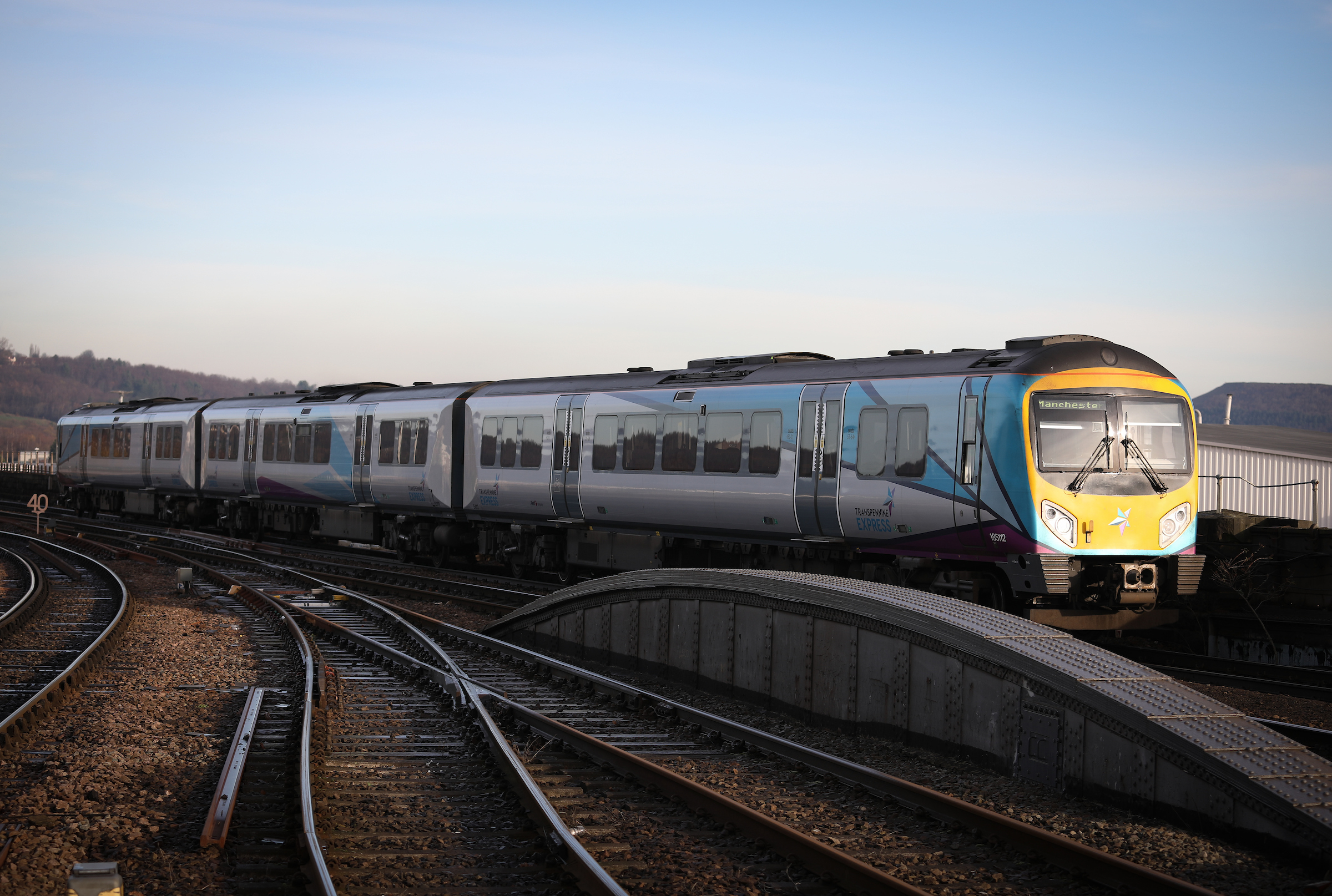
Rail operator TransPennine Express (TPE) has started work to install the units on all 51 of its Class 185 trains over the next two months, and can be used by both staff and passengers if someone goes into cardiac arrest.
The defibrillators will be fitted by technology company Siemens Mobility, and will be located in an emergency equipment cupboard in the middle of the train.
Every defibrillator being installed on the trains has step-by-step, spoken word instructions built in to them, which explain how to use on someone in an emergency, so passengers and staff need not panic if they’re unsure what to do.
Computers inside the defibrillators will work to analyse a person’s heart rhythms to find out if an electric shock is needed, and if required, electrodes then automatically deliver the shock.
⚡Work has started to fit defibrillators across more than 50 TransPennine Express trains
🚆 The life-saving units will be installed on all 51 of our Class 185 trains by the end of March
The defibrillators – which are already installed on TPE’s Nova 1 trains – have been purchased from the British Heart Foundation charity, which is the biggest independent funder of heart and circulatory research in the UK.
The news that the defibrillators are being installed on trains travelling through Greater Manchester and across the UK come after it was announced back in 2023 that the machines were being installed at more than 100 Northern stations to help save people in cardiac arrest.
Speaking on the installing of the defibrillators on trains, Bushra Khan, who is the Head of Engineering at TransPennine Express, said: “Our defibrillators are a huge benefit to both our customers and the communities we serve.
“This rollout will ensure that people travelling on our services will feel safe and confident that defibrillators are available to help in the event of an emergency, potentially saving lives.”

 Daisy Jackson -
16th May 2023
Daisy Jackson -
16th May 2023